Barbershop at the Library
By Eva Green
(Originally published via WYCC PBS Chicago)
In Chicago’s West Englewood neighborhood, where crime is often prevalent, one local library is offering young people an innovative opportunity to navigate the trauma and violence they experience in their daily lives. Through a collaboration of local business owners and mentors, youth are given the space to share their struggles, get a fresh haircut, and gain a new perspective on their futures.

“I’ve never seen so many acts of violence and it being so normal in my life,” Isaiah Brewer, 20, says as he sits in a circle of his peers in the West Englewood Library. “We act like its cool, we act like it don’t matter,” he says. “We are betting on how many people get shot. We hear gunshots and we still keep cooking!”
Behind the group of youth, hair clippers are buzzing and two barbers are busy at work. Once a month, Brewer and a handful of others teens gather in a meeting room at the library to share their stories, exchange a few laughs, and even shed some tears.
(Produced by Eva Green)
Michael James, a young man in the group slumps in his chair but still speaks up as the group switches topics to discussing their goals. His head hangs low and he gazes down at his white sneakers that are tied loosely with bright red laces. “My motivation is you know, choose another path to go down. Do what’s right,” he says trying to hide evident tears. “I would hate for my Mama to lose another child.”
“Barbershop at the library is by far the greatest idea they have ever come up with at the library…”–Isaiah Brewer

Adewole Abioye is the teen services representative and started Barbershop at the Library in 2015 with a mission in mind as part of an On The Table conversation, an initiative of the The Chicago Community Trust.
“Kids were talking in a very honest open way and a lot of them had a lot to say and we realized wow this is really important, how this would look if we did this on a monthly basis,” he explains.
On The Table events aim to start conversations among Chicagoans from all backgrounds. The demand in Englewood was so strong that the barbershop talks were expanded.
“There is a lot of trauma that a lot of people deal with on a daily basis, whether its physical violence, whether its psychological violence, it’s happening,” Abioye says. “That burden is weighing on them so how can we get them talk about these things in a very honest and open way?”
That is where Kenneth Clayton, who owns Longevity Barber Lounge, and fellow barber Darius Smith, known as “Red”—joined the partnership.
They brought their shears and a strategy to transform perceptions of the neighborhood.
“All over the United States you have urban communities like Englewood that have a negative stigma,” Clayton says. “The gangbanging, drug selling, the shooting. I just basically want to change that.”
Clayton says those changes can start in small ways, such as giving kids a fresh cut, helping to build their self-esteem. He insists on shirts and ties for his barbers. No displays of gang symbols or colors are allowed in his shop and he says he hopes others will follow his lead in the city’s most difficult neighborhoods.
“Whoever you are, you have to be able to give back finances, labor, knowledge and wisdom,” he says. “Now if every individual did that, watch how this community change.”
It is clear that the bonds between the barbers and these young people are getting stronger. Each haircut offers a chance to connect with adults who care enough to listen.
“A lot of them want to be heard and they want to know that their voice matters and I think we have created an environment where teens can come and literally say anything,” Abioye says. “Hopefully that will lead to something even greater.”
(Please click here for links to originally published samples-WYCC PBS Chicago.)
Reforming Illinois’ Sex Offender Laws
By Eva Green
Sex offender registry laws are under the microscope with the creation of a new task force aimed at examining the effectiveness of current sex offender laws throughout Illinois.
“I want our criminal justice system to work,” State Representative Elgie Sims (D-Chicago) who is helping lead the effort said at a recent task force meeting in downtown Chicago.
“I want our communities to be safe and I am always looking for ways to improve on what we are doing,” he says.
(Produced by Eva Green)
Among those in attendance of the public hearing were two mothers sitting on different sides of the room. Both were there to share their stories, but for very different reasons.
“I changed as a mom that day. Stephanie has changed, our whole family has changed,” says Tina Estopare, a former Plainfield resident, describing the 2011 sexual battery of her then 15-year-old daughter Stephanie. The perpetrator Clifton Kucha (name has been changed) was a neighbor and friend of the family.
“He had her in the room, in the basement for 3 hours with his two year old son in the room watching,” Tina Estopare described.
Kucha was ultimately charged and convicted of misdemeanor battery but was not required to register as a sex offender in Illinois. The crime, though legally deemed sexually motivated, slipped through what Tina Estopare describes as a loophole in the system.
“We had asked the states attorney to register him on the sex offender registry,” she says. “I automatically assumed that is what it would be because it was of sexual nature of what happened and the states attorney asked and the judge said that in the state of Illinois, battery is not considered a sex offense.”
Since the assault of her daughter, Tina Estopare has gathered over 300 letters of support from school superintendents, park districts, and law enforcement in support of a bill that would close the loophole. HB 0816, also known as “Stephanie’s Law,” would allow judges’ to require someone convicted of sexual battery to register as a sex offender in Illinois. The current bill has over 70 legislative sponsors but still has not been passed into law.
“I think some of the biggest challenges are the fact that we are in this wave of recidivism, we are trying to say that there are too many people in prison and that we need to be softer on crime and especially on this issue I disagree,” says State Representative Mark Batinick, (R-Plainfield) one of the bills co-sponsors.
Rep. Batinick says another concern is that under the current database, sex offenders are not classified based on the severity of their crimes or their risk to the public.
“Clearly all sex crimes are not the same,” Rep. Batinick says. “Looking at the computer is certainly different than attacking a minor in a park, which is different than two teenagers that do something consensually,” he says.
 In Illinois there are over 29,000 people on the sex offender registry, according to the Illinois State Police Registration Unit. This public database gives law enforcement and the public information on where registered sex offenders live, and bans offenders from being within a certain distance of schools, parks, and other areas frequented by children.
“It seems like we are missing people that are doing some of the more serious crimes and not making the registry altogether and we are capturing some of the ones that maybe it was not as serious as some of the people who are not even on it,” Rep. Batinick says.
Carol Nesteikis of Oak Forest attended a recent task force meeting and says the tentacles of the current sex offender laws are far-reaching and destroying families. In 2012, her mentally disabled son David (name has been changed) was persuaded by a neighbor, who had also been molesting him, to engage in an act with an underage female victim.

“He was arrested with the neighbor and prosecuted, and he ended up on the registry for 10 years,” Nesteikis says.
Nesteikis and her husband accepted a plea deal to keep David out of jail. The original charges of 19 felonies were reduced to a misdemeanor which required him to wear an ankle bracelet as part of his two year probation sentence. “He was fitted with an ankle bracelet that he was so scared of he slept for two years with his leg on a pile of blankets,” Nesteikis says. “He was so afraid that if he moved it would go off and they would come to get him.”
David’s sentence and label as a sex offender also required him to move away from his neighborhood because the female victim lived nearby. His disabilities inhibit him from caring for himself, dividing their family and forcing Nesteikis’ husband to find a new residence where he could care for their son.
“My son does not understand any of what is going on here,” Nesteikis says. “His attorneys had to whisper things he had to say in court to the judge,” she says.
The entire ordeal has costed Nesteikis and her husband over $150,000 in legal fees and the cost of having to re-locate David. It has also put constraints on her entire family, limiting future plans to the registry restrictions, limiting where they go each day and forcing David into isolation.
“He was very active in special recreation and Special Olympics,” Nesteikis says. “That was his life, he can’t do any of that anymore.”
David also lost the part-time job he had cleaning tables following the sentence. Nesteikis says the last two psychologist analysis’ report his IQ is falling due to lack of stimulus and seclusion.

(Nesteikis speaking to the Illinois Sex Offender Task Force meeting in Chicago)
But like Tina Estopare, Carol Nesteikis hasn’t given up either. In addition to co-founding the group Legal Reform for Intellectually/Developmentally Disabled (LRIDD), she continues to advocate on behalf of her son through her work with other groups like The Arc and Women Against Registry. In Chicago, she stands before the task force committee sharing David’s story, and pleading for changes to sex offender laws on behalf of countless other parents whose children have disabilities too. The current laws are destroying families, she says. They are putting people like David at even greater risk by publishing his address, making him a potential by vigilantes who see him as a threat to the community.
“It’s not protecting the victims and it’s not protecting people like my son who has disabilities,” Nesteikis says of current sex offender laws. “It involves everybody and nobody is benefiting from it.”
The Sex Offenses and Sex Offender Registration Task Force is also being led by the Illinois Criminal Justice Information Authority and working with experts in the field, law enforcement, community-based organizations, and people affected by current registry laws. The task force is assigned to deliver their findings and recommendations, based upon research and public hearing, to the Illinois General Assembly by January 2018.

(Tina Estopare speaking to the Illinois Sex Offender Task Force in Chicago)
______________________________________________
Trumps’ Tweets Surprise Spicer
By Eva Green
Incoming White House Press Secretary Sean Spicer admitted that he does not know what will be released on Twitter prior to the President-elect Donald Trump’s social media postings. “He drives the train on this,” Spicer says.
 Steve Edwards, executive director of the Institute of Politics welcomed Spicer to a panel discussion at the University of Chicago. Spicer was joined on the panel by David Axelrod, director of the University of Chicago’s Institute of Politics and Robert Gibbs, former White House Press Secretary to President Barack Obama.
Moments into the event, an audience member who mirrored complaints by outside protestors, was removed for disrupting the event alleging that Spicer was a press secretary to an incoming president who “opposes the media.”
“This isn’t normal people,” he shouted as he was removed from the event. “There is an option to stand up!”
Despite the initial interruption, the event continued with a cordial tone throughout the nearly hour and a half event. Topics of discussion among the panel included Trump’s campaign efforts, information released by Wikileaks, Hillary Clinton’s emails, media bias, and the President elect’s use of Twitter.
Spicer declared that Trump’s use of Twitter steers media coverage and says that news coverage often lacks substantial value. “It’s become a race to be first,” he says.
During the conversation, the audience listened intently as Axelrod presented allegations that Trump is known by some as the “Clickbate King.” Questions regarding the accuracy of the President elect’s Tweets were also raised.
“He (Trump) has the right to express himself on Twitter,” Spicer says.
The panelists also went on to discuss the accuracy of media outlets as well as the intentions of journalists. It is the job of journalists to release correct information, Spicer says.
During the latter part of the evening, a line of people with questions filled the aisle of the room. Questions varied from international relations to the role of the media with the incoming administration.
David Abraham, a participant in the line asked Spicer to explain President-elect Trump’s “relationship to the truth” and declared there to be an abundance of inaccuracies that he has released to the public.
“He believes what he says,” Spicer says. “My job is to represent his beliefs.”
_____________________________________________
Chicago Cubs Fan of the Year Inspiring a Generation of Hope
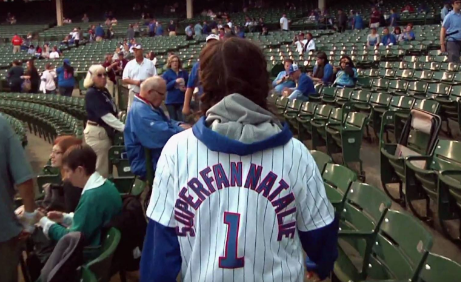
In many ways, Natalie Adorno is a typical high school freshman at Guerin College Preparatory High School. She balances her days at school, with homework, friends and volleyball practice. Like many, she is a Cubs fan, but in that regard she is anything but typical.
Adorno’s love of the Chicago Cubs started early, a passion inherited from her parents. When she was 11 years old, they bought season tickets and she got a chance most fans only dream off.
“They had picked me to say ‘play ball’ in the press box and from then on everyone started recognizing me,” Adorno says.
Soon, the little girl with the big love for the Chicago Cubs was spreading her enthusiasm around section 527, an area once filled with strangers is now a family to her. She was even given the nickname Superfan Natalie. When she created a Twitter account to share her experiences at games, she became an instant celebrity.
“The players started recognizing me more so then they started tweeting me and so did the Cubs organization” says Adorno.
But being a super fan in the fickle world of social media hasn’t always been easy for Adorno. Three years ago a disgruntled fan took to Twitter, bringing controversy to her enthusiasm by calling her cheering “annoying.”
“I don’t think I cheer too loud,” she says. “We are outside and we are at a ballgame, I think we are supposed to cheer.”
Like the Chicago Cubs, Adorno hasn’t given up, gaining recognition from sportcasters, landing on the front page of the Daily Herald newspaper, and being named the 2016 Cubs Fan of the Year.
“This is the bat I got for being the Cubs Fan of the Year that I recently won” says Adorno showing memorabilia ranging from Wayne Mesmer’s hat, Ernie Banks’ autograph and Travis Wood’s jersey, all given by the players themselves.
This year is different, she says. The curse of the once lovable losers has been crushed in her mind by fresh faces on the team, and a management that is taking them so far in recent years.
As the tension of the series build, Adorno brings the innocence of a new generation to her beloved team, a heart that is a reminder to never give up, and the belief that this could be the year for the Chicago Cubs.
 Eva Green